

Workplace Asbestos Air Monitoring: Testing, Exposure Limits and Regulatory Requirements
Workplace asbestos air monitoring measures airborne asbestos fibre concentrations during work on asbestos-containing materials. It supports the assessment of occupational exposure, the selection of protective measures and compliance with French regulatory requirements.
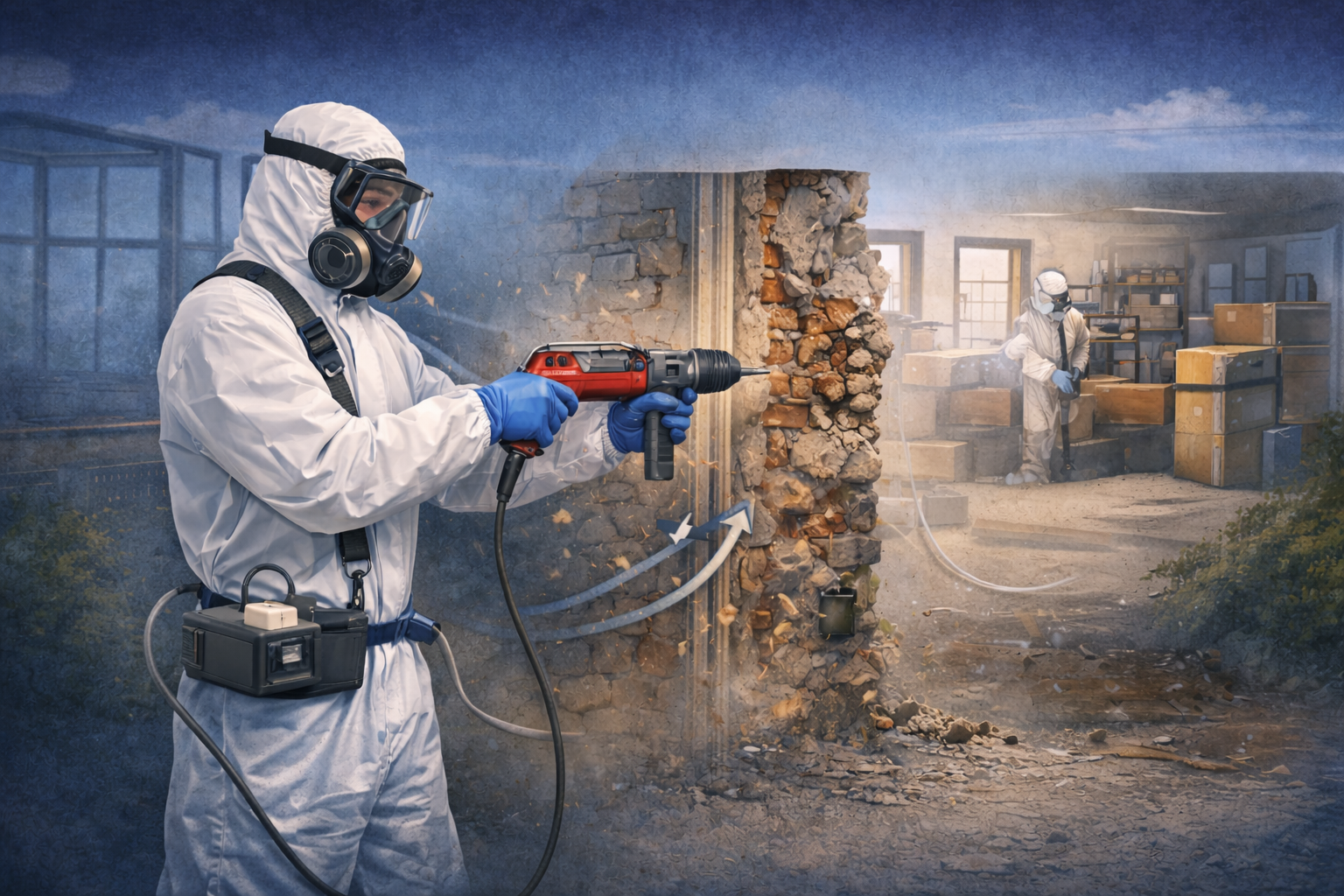
Personal asbestos air sampling involves collecting air close to the worker’s breathing zone. It provides data on airborne fibre concentrations during the activities being assessed.
Important: a sample collected outside respiratory protective equipment does not directly measure the concentration inhaled inside the respirator. Occupational exposure assessment must also consider the duration of the different activities and the respiratory protection used.
What is workplace asbestos air monitoring?
Workplace asbestos air monitoring uses personal air sampling in the worker’s breathing zone. The results are expressed in fibres per litre of air (fibres/L) and help characterise airborne concentrations under actual working conditions.
Why assess workers’ exposure to asbestos?
- Assess potential occupational exposure to asbestos fibres
- Support checks against the occupational exposure limit (OEL)
- Inform the selection of suitable respiratory and other personal protective equipment
- Assess the effectiveness of containment and collective protective measures
- Document compliance with the applicable requirements
When is workplace asbestos air monitoring needed?
- Asbestos removal or encapsulation work under French Subsection 3 (SS3)
- Work liable to release asbestos fibres under French Subsection 4 (SS4)
- Assessment and validation of working procedures
- Asbestos worksite monitoring
- Assessment of exposure control measures
Asbestos monitoring for SS3 and SS4 activities
The French regulatory framework distinguishes between Subsection 3 (SS3), covering asbestos removal and encapsulation, and Subsection 4 (SS4), covering interventions liable to release asbestos fibres.
Airborne fibre assessment and occupational exposure checks form part of the prevention requirements for these activities. The measurement programme must be adapted to the activity, the processes used and the applicable requirements.
Results help assess compliance with the French occupational exposure limit and determine appropriate protective measures.
How is workplace asbestos air monitoring carried out?
- Define a sampling strategy appropriate to the work being performed.
- Fit the worker with a personal sampling pump.
- Collect air through a suitable filter positioned in the breathing zone.
- Analyse the samples in a specialist laboratory.
- Interpret the results in context and issue a detailed report.
French occupational exposure limit for asbestos
The French occupational exposure limit, known as the VLEP, is 10 fibres per litre of air averaged over eight working hours. It applies to the air inhaled by the worker.
An individual sampling result should not be interpreted in isolation: the assessment must account for the work periods, exposure conditions and respiratory protection. The measured concentration outside a respirator is not automatically equivalent to the eight-hour inhaled exposure.
Sampling and analytical methods
Samples are collected using personal sampling pumps and suitable filter holders. The filters are analysed using standardised methods, including analytical transmission electron microscopy (ATEM/TEM), to identify and count asbestos fibres.
Frequently asked questions about workplace asbestos air monitoring
What is the difference between personal sampling and environmental monitoring?
Personal sampling measures airborne concentrations near a worker’s breathing zone and supports individual exposure assessment. Environmental monitoring measures the ambient air at a selected location within or around a worksite.
Is workplace asbestos air monitoring mandatory?
It is required in the circumstances covered by the applicable French regulations. The scope and timing of measurements depend on the activity and the purpose of the assessment.
What equipment is used?
Personal sampling pumps worn by workers, with suitable filters for collecting airborne fibres.
Who should carry out these measurements?
Regulatory measurements must be entrusted to an appropriately accredited organisation. Its accreditation scope must cover the relevant sampling strategy, sampling and analytical activities.
Why choose BJL Laboratoires?
- Technical support with the sampling strategy
- Reliable analysis and clear interpretation of results
- Reports supporting contractors and inspection bodies
- Responsive on-site services
Workplace asbestos air monitoring in Paris and Île-de-France
BJL Laboratoires provides workplace asbestos air monitoring for construction and industrial professionals in Paris and Île-de-France.
Service area: Paris, Saint-Denis, Nanterre, Créteil, Versailles and the wider Île-de-France region.
Learn more about asbestos air monitoring
Explore our related pages:
- Personal asbestos air sampling
- French asbestos exposure limits and requirements
- Asbestos removal worksite monitoring
See also: asbestos testing laboratory near Paris | asbestos testing in materials.
BJL Laboratoires – specialist workplace asbestos air monitoring to support worker protection and asbestos risk management.